
Fishing with beads is certainly all the rage these days for trout, dollies, grayling, steelhead — and even salmon. Delivered via a fly rod or fished under bobber on spinning gear, it’s hard to deny the effectiveness of both hard plastic and soft beads. The little orbs work in a myriad of situations but are perhaps most effective when spawning salmon are present.
You’ve probably read about — or experienced — how trout and char in particular can get frustratingly selective when there are lots of loose eggs awash in a spawning stream. They see the real thing drifting along by the thousands so if your offering looks even slightly off, it’s going to get ignored. That’s of course how pegging the bead up away from the hook got started but anglers soon found that there was a lot more to it than that.
Having exactly the right size bead to match that of the spawning species is often essential — as is matching the color of the egg in terms of species and freshness.
Match the Hatch?
While “matching the hatch” is the key to success in most situations, I have also found that there are times when you can throw convention out the window and go almost the opposite direction.

The fist time I learned this lesson was on a small stream near Bristol Bay. I had a couple anglers who wanted a break from conventional salmon fishing and liked the idea of going after trout and dollies with a fly rod. I had just the place: A long, shallow flat absolutely loaded with spawning chums. I pulled the little sled over on a gravel bar and walked my guys up to the spot.
Before we fished, we climbed a high bank and looked down onto the flat. There were probably a couple hundred salmon working on redds in there. Behind the salmon were dozens and dozens of dark, slightly smaller shapes — big rainbows and char that were gorging themselves on eggs.
Chum eggs are pretty good size, so I rigged my guys up with 10 mm beads in a light orange color to perfectly mimic the eggs the salmon were releasing. I pointed the anglers in the right direction and then grabbed my needle nose pliers in anticipation of the un-hooking madness that was sure to come. Only it didn’t…
Neither of my dudes got bit on their first few casts but I’d seen that happen before. It was simply a matter of switching out the bead color. The color of a salmon egg can vary, based on location, water temperature and how long they have been in the water. So, I gave the clients a couple slightly different shades or orange and peach and set them back out into the run. Same result. Well, perhaps the eggs were older than I expected, so I switched them out to more opaque models since real salmon eggs turn cloudy or creamy when they’re dead.
After a half an hour of working over a teeming horde of actively feeding fish without a grab, I got frustrated and put a 12 mm hot pink BnR Tackle bead on one of the guy’s rods.

I really didn’t have a good reason for it other than the fact that I had run out of conventional wisdom. Well, you can probably see where this is headed: The guy immediately started catching a good 3 plus pound dolly or rainbow on every single cast! I switched my other client to the “pink wonder” and he quickly got in on the fun too. They must have landed 30 gorgeous fish off that flat — every single one with that funky pink ball in their mouths.
Since then, I have pulled that one out of my bag of tricks many times when the bite was lackluster. It doesn’t always produce the same results that I saw on that first day but it has been a trip saver on many occasions. I’m not totally certain what’s going on in those cases but my best guess is the color change somehow makes it easier for the fish to key in on the bead. It may just be that the pink (I’ve also tried dark red and chartreuse with good results) stands out just enough against the zillions of orange eggs down there.
When you think about it, it makes perfect sense. The “stand-out” bead may appeal to the predatory instinct that fish use to spot the one wounded baitfish in a school. They’re used to locking onto the loner or injured forage fish against a backdrop of hundreds or thousands of others and that may be what, in effect, is happening in this situation.
Of course, it’s hard to say but whatever the reason, I know changing to a completely contrasting bead — even when the conditions suggest you shouldn’t — is definitely something to keep in the back of your mind when the fish are playing hard to get.
“Thunder Beading”
I have also found that there are days when a technique I call “Thunder Beading” out-fishes all others. It’s really just a hyped up name for using a much larger bead than you’d normally would.

Just like the technique I described above, I stumbled onto this one by accident. One afternoon on a tributary to the Nushagak River, I had a couple clients casting 6 mm beads to match the small sockeye eggs that the rainbows, dollies and grayling were munching on.
The fish they were catching were relatively small — the grayling were all 12-13 inches and the trout and char were topping out around 18 inches. Still, my guys were having a ball catching fish every cast. I, on the other hand, was getting bored. They boys didn’t need my help so I was just hanging out on the bar watching the occasional school of fresh silvers work their way upstream.
Though silvers can become monotonous later in the year, those were the first of the season and I desperately wanted to hook one. Not armed with any silver-specific patterns, I decided I’d put on the biggest thing I had in my box — a 16 mm orange soft bead that somebody had given me to try. That thing looked like a golf ball in my bead box next to all the other 6 to 10 mm sizes but it was the only thing I had that seemed large enough to get a silver’s attention.
I waited around for a few minutes until the next migrating pod of coho came into view and then I lobbed my “Thunder Bead” into the run ahead of them and was shocked to see the indicator go down immediately. At first, I thought I’d hooked the lead coho but then realized I was fast into a 26-inch rainbow! Purely coincidence…or so I thought!
As it turned out, I started putting a pretty good beat-down on really nice trout and char with that kooky jumbo egg. It didn’t take long for the clients to notice I was catching much larger fish than they were so I handed one of them the rod with the big bead on it and he caught several good fish from 22 to 28 inches before he finally lost it on a snaggletoothed chum’s dorsal fin.

I’m always fascinated by what makes fish do what they do and the riddle of the big beads catching big fish kept me up thinking that night. We didn’t even know there were any big fish in that section of creek until I started using that tennis ball of an egg imitation. The obvious answer to it is the whole “big bait, big fish theory” but I wanted to read more into it.
As I noted earlier, trout can get crazy-selective when they’re focusing on eggs, so this behavior was pretty weird. Could it be that the big egg simply presented a better protein gained for energy expended ratio to the trout and dollies? Hypothetically, it took the same amount of energy for the fish to move to and grab the 16 mm bead as it would for them to take one of the sockeye eggs half its size. So, all things bing equal, the monster egg presented a better deal to them — especially when you consider it was fall and the fish must inherently feel the end of the season coming sooner than later.
There’s always a good chance that I’m over-thinking the situation and that the big bead was just easier to spot — kinda like the pink one in the sea of orange eggs I described above. I suppose you could also argue that, due to large size of the bead, there was less competition for it. The grayling certainly couldn’t get their little whitefish mouthes around it, nor could the smaller trout. Therefore, one could theorize that the largest fish in the run would be the most interested in the “Godzilla Egg.”
I suppose its sometimes best to just accept that something works without overanalyzing it. Just take my word for it, there are times when the biggest bead in your box is the one the fish will want!
I have also found large beads to be the ticket when the water is off-color due to the fact they are more visible. The larger profile of a 14 mm or 20mm bead in extremely cold water can sometimes coax otherwise lethargic fish in to striking when smaller presentations are ignored. Thunder beads also really seem to shine when there are no spawning fish in a river. Though the fish aren’t dialed into eggs at that time, they are still very familiar with the round shape and color of a large bead and eat them frequently.

Since I started fishing a lot of larger-sized beads (even up to the 40 mm size), I have noticed that salmon are pretty keen on them as well. Kings and silvers in particular have a taste for big beads but I have also caught plenty of chums, pinks and even reds on them as well. And that’s what really makes fishing these things fun — you just never know what you are going to catch when you have one on the end of your leader our tippet.
I guess the moral of the story here is to remember that fish often act in ways that we don’t fully understand. In the context of fishing with pegged beads under either a bobber or an indicator, keep in mind that perfectly matching the hatch doesn’t always ensure success. There are times when going against the grain and throwing something completely different at the fish pays huge dividends.
I’m a big fan of BnR Soft Beads, which you can get HERE.
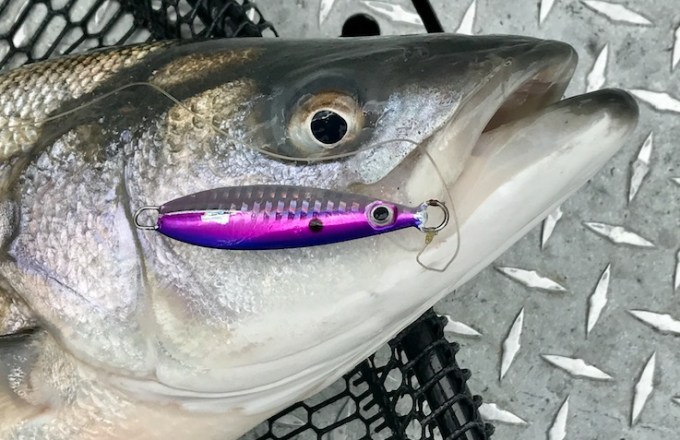 Spooning (aka: “jigging”) is one deadly technique for ocean salmon, halibut, yellowtail and rockfish, along with trout, landlocked salmon, striped bass and walleye in freshwater.


 Alaska’s Togiak River has a rich reputation for being a world-class king salmon fishery, but there’s a lot more to this Southwestern gem than meets the eye.
 “The Togiak is a great river for nice, big fish,” says Kevin Lund, whose family owns Togiak River Lodge. “It can be cyclical, but the normal size range is around 25 to 30 pounds.”
 Togiak kings are super snappy and, when they’re around in any kind of numbers, are pretty easy to hook. Back-trolled HawgNose Flatfish, MagLip 5.0, and K16 Kwikfish will all produce in chartreuse/chrome, pink/white and chartreuse/metallic blue/chrome. A fresh sardine fillet wrapped to the belly of the plug will increase the number of bites you get, but isn’t as essential here as it is on other rivers.
 While a few silvers will poke their noses into the Togiak in early August, fishing is usually pretty inconsistent during the first ten days of August. According to Lund, the fishing is nearly always going strong by Aug. 15 and, depending on water and weather conditions, it can carry on into October — though weather becomes an issue the later you get into the season.
 “The river doesn’t just have big kings in it, the silvers run large here too,” says Lund. “The biggest we’ve seen at the lodge have been right at 20 pounds, with lots of 15 to 17 pounders caught each year.”
 Because of their numbers and willingness to bite, the Togiak is a phenomenal place to chuck some fluff. Anglers stripping pink streamers and leeches on intermediate sink tips can pile up ridiculous numbers here. Some of the bars just above the mouth of the river will also produce topwater action on Pink Wogs.
 The Togiak doesn’t get the press about trout fishing that some other rivers just over the hill in the Wood-Tikchik dragline receive, but don’t let that fool you. The river plays host some wonderfully large rainbows that can top the 30-inch mark. The largest any of Lund’s guests have taken is 16 pounds!
 Reds show up in prime condition, silver and full of fight. They can reach very impressive sizes here, with 12 pounders showing every season – pretty impressive when you consider the world record for the species is 15 pounds and change.
 Togiak chums are eager biters and seem extremely receptive to the swung fly. In most cases, you can fish a dry line (some of the best chum runs are only a few feet deep) with just about any type of “leechy” pattern you like. Pink is your number one color, though there are times when they respond better to purple or black.
 Okay, let’s call a spade a spade here. Humpies are more of a nuisance on the Togiak than anything else. For the record, I’m not a humpy hater. I’ve spent a lot of days chasing the little buggers around with fly gear throughout the state and had a ball doing it, but on a river like the Togiak, it’s a different deal. There’s so much potential here for the “glamour species,” that pinks just don’t come into play very often. But in their defense, it can be great fun for kids or beginners if you find a big pack of bright, fresh-from-the salt humpies to play with.
 They show up fresh from the salt and chrome as can be, in the early summer and fishing is often outstanding in the lower river in June and July and then the fish migrate upstream into the tributaries to dine on salmon eggs. By late summer, the dollies will have made the transition from silver to Technicolor, prettying themselves up for a spawn of their own.
 Weedless topwater lures and buzzbaits thrown in and among the weeds and lily pads will solicit some heart-stopping attacks from pike, which will generally measure three feet or less.
 GUIDES AND LODGING

 How well do you know your trout, salmon and steelhead? Well, take this little quiz and find out — and then read on for the detailed answers…